Can you really get a decent home exercise bike for under £250?
That was exactly the question I wanted to answer when I bought the Merach Exercise Bike. This wasn’t a sponsored review and I paid for the bike with my own money, so these are my honest thoughts after using it for the last few weeks.
If you’ve been looking for a budget-friendly exercise bike for home workouts but don’t want to spend Peloton money, hopefully this review will help you decide whether the Merach bike is worth considering.
Why I Wanted a Home Exercise Bike
Earlier this year I was on holiday and I found myself jumping on an exercise bike, putting my headphones in and doing my own little spin class.
I used to teach spin classes years ago, probably 10 or 12 years ago now, and I absolutely loved them. Since then I’ve always enjoyed cycling workouts, but I wanted something I could use easily at home.
My body doesn’t really love running as much as it used to, and cycling is generally a little kinder on the joints while still giving you a great cardiovascular workout.
I already have a home gym. I have a rowing machine and an air bike, but let’s be honest, how many people genuinely enjoy spending more than 10 minutes on an air bike?
What I wanted was something simple that would allow me to put on some music, follow a spinning workout and work on my cardio fitness from home.
Because at the end of the day, the best workout in the world is the one you actually do.
When exercise is convenient, you’re much more likely to stay consistent with it.
Why Not Just Buy a Peloton?
The obvious comparison is Peloton.
At the time of filming, a Peloton bike is retailing for around £1,600. That’s a huge investment and not something everyone wants to spend on a piece of fitness equipment.
So I started wondering whether a budget exercise bike could do everything most people actually need it to do.
Would I be sacrificing quality by spending less money?
That’s what I wanted to find out.
First Impressions and Assembly
The bike arrived well packaged and took me just over an hour to build.
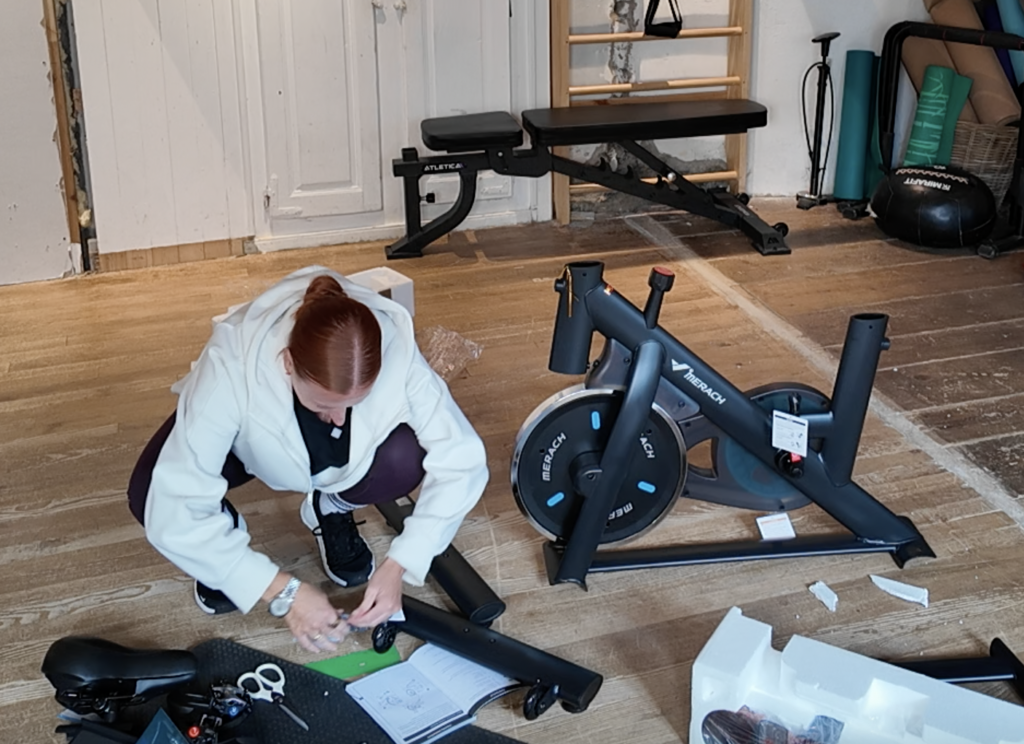
There were a couple of fiddly bits along the way and I made a few mistakes that meant I had to undo things and start again, but overall the process was straightforward.
Everything I needed was included in the box and I didn’t need any additional tools.
Once assembled, my first impression was that it felt surprisingly sturdy and stable.
It also doesn’t take up much room.
One of the things I really like is that it’s easy to move around. There are wheels on the front so you can tip it up and roll it into position if needed. That means you can tuck it away when you’re not using it and bring it out when you want to train.
It’s compact, sturdy and easy to manoeuvre.
The Model I Chose
I opted for the cheapest version of the Merach bike, which uses a pad resistance system.
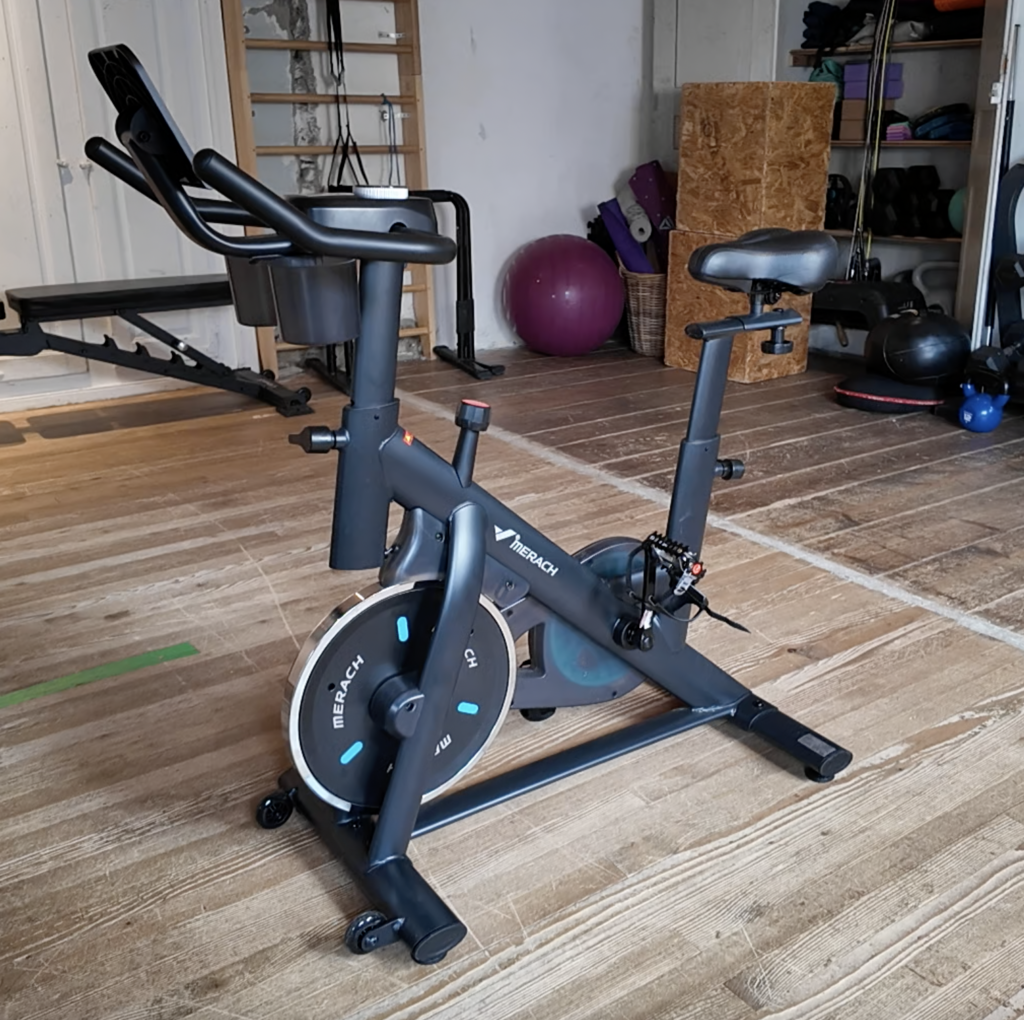
You can spend slightly more and get a magnetic resistance version, which may provide a smoother ride, but honestly I didn’t find this version clunky at all.
The resistance is adjusted using a dial at the front of the bike. There aren’t numbered resistance levels, but that’s pretty common on traditional spin bikes.
I found that even small adjustments created a noticeable increase in resistance, so it was easy to find a level that felt challenging.
At the time I purchased it, I paid around €180, which worked out at roughly £150.
For a bike at that price point, I was genuinely impressed.
What Is the Merach Bike Like to Ride?
This was probably the biggest surprise for me.
The ride feels smooth and, more importantly, it’s incredibly quiet.
There is very little noise coming from the bike itself. No rattling, no vibrations and no annoying sounds while you’re cycling.
If you’ve got uneven flooring, there are adjustable feet underneath the bike to help level it out.
The seat and handlebars are also adjustable, allowing you to raise and lower them to find a comfortable riding position.
One area where you can tell this is a more budget-friendly bike is the adjustment system itself. You need to loosen the adjustment knob, pull the pin, move the seat or handlebars into position and then tighten everything back up.
It’s not difficult, but it’s not quite as refined as some premium bikes.
I did notice a slight wobble in the handlebars initially, but once I tightened everything properly it felt much more secure.
Comfort and Fit
One thing I wasn’t expecting was how comfortable the seat would be.
Anyone who’s spent time on exercise bikes knows that saddle comfort can make or break the experience.
Thankfully, the Merach seat has plenty of padding and has remained comfortable throughout the workouts I’ve done so far.
The bike also offers enough adjustment options that I was able to find a riding position that felt natural and comfortable.
The pedals come with toe cages and adjustable straps, which work perfectly well for most people.
I don’t currently use proper cycling shoes and during one longer 45-minute ride I did notice my feet becoming slightly numb. However, that was more down to my footwear than the bike itself.
If you’re a keen cyclist and want to use cleats, you could replace the pedals with compatible cycling pedals.
Display and App Features
The bike includes a basic display that allows you to track metrics such as:
- Time
- RPM
- Distance
- Calories
- Other workout data
It also has Bluetooth connectivity, which means you can connect it to compatible workout apps.
Merach has its own fitness app, and I actually thought it was pretty good.
The app includes guided workouts, training programmes and workout tracking. You can even connect a heart rate monitor if you want more detailed feedback.
I liked how easy it was to use and how seamlessly it connected to the bike.
The only thing that wasn’t really for me was the music.
Music can make a huge difference to a workout experience and I found the music in the Merach workouts a little flat.
That said, this is very personal and will come down to individual preference.
Testing Different Cycling Apps
Alongside the Merach app, I also tested a few other cycling platforms.
These included:
- Peloton
- Les Mills RPM
- Other home cycling apps
Out of everything I tried, Les Mills RPM was probably my favourite.
However, the great thing is that you aren’t locked into one platform. The bike works well with a variety of apps, and many of them offer free trials so you can find the style of coaching and workouts that suit you best.
Who Is This Bike Best For?
I think this is where the Merach Exercise Bike really shines.
If you’re looking for a home exercise bike to:
- Improve your general fitness
- Lose weight
- Increase cardiovascular fitness
- Follow spinning classes at home
- Stay active without joining a gym
then this bike is fantastic value for money.
It’s also a great option if you’re new to indoor cycling and don’t want to spend a fortune getting started.
Who Is It NOT For?
If you’re a serious cyclist looking for elite-level performance, advanced power metrics or a commercial-grade training experience, this probably isn’t the bike for you.
You may be better served by one of Merach’s higher-end models or a premium brand.
This bike is designed for everyday people who want an affordable and convenient way to exercise at home.
My Final Verdict
For less than £200, I honestly don’t think I could ask for much more.
The bike is comfortable, quiet, smooth to ride and offers Bluetooth connectivity so you can connect to a range of workout apps.
The build quality feels solid, it doesn’t take up much space and it comes with a 24-month warranty, which is reassuring to see.
Is it going to rival the biggest premium brands?
Probably not.
But that’s not really the point.
If you’re looking for a budget-friendly exercise bike that helps you stay consistent with your workouts and improve your fitness from home, I think the Merach Exercise Bike offers excellent value for money.
I’ve genuinely been impressed with it and would happily recommend it to anyone looking for an affordable home exercise bike.
If you’ve got any questions about the bike, feel free to leave them in the comments below and I’ll do my best to answer them.
Leave a Reply